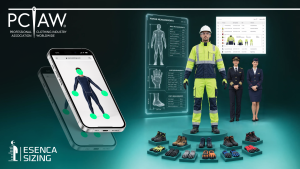
Finding the perfect fit for uniforms in industries like law enforcement, firefighting, aviation, cruise, and defense has been a longstanding challenge, particularly for women. Historically, uniforms have been designed with a “one-size-fits-most” approach, often based on male body proportions. This has led to discomfort, decreased mobility, and even safety concerns for women working in these physically demanding roles.
However, cutting-edge technology, such as 3D body scanning from platforms like Bodd.io, is transforming the way uniforms are sized and tailored, offering unparalleled precision and efficiency.

The Challenge of Uniform Fit for Women
Traditionally, uniform sizing has relied on outdated methods, including standard measurement charts and manual fittings. This often results in:
- Poorly fitting uniforms that are either too tight or too loose
- Restrictions in movement that hinder performance
- Increased risk of workplace injuries due to ill-fitting gear
- The need for costly and time-consuming alterations
For women in uniformed services, these challenges are amplified due to anatomical differences from male colleagues. Traditional uniform designs often fail to account for the unique proportions of women, leading to issues that compromise comfort, safety, and appearance. 3D body scanning technology presents an innovative solution that ensures accuracy, inclusivity, and efficiency in uniform design and distribution.
The biggest challenges in sizing uniforms and apparel for women stem from the diversity in body shapes, inconsistent sizing across brands, and the reliance on outdated measurement methods. Here’s a breakdown of these challenges and how 3D body scanning can help:
Challenges in Sizing Clothing for Women:
- Variation in Body Shapes
- Women’s bodies come in a wide range of shapes (e.g., hourglass, pear, rectangle, apple) and crucially different proportions including breast size and hip-to-waist ratios. Traditional sizing charts often fail to account for these differences, leading to inconsistent fit.
- Women’s bodies come in a wide range of shapes (e.g., hourglass, pear, rectangle, apple) and crucially different proportions including breast size and hip-to-waist ratios. Traditional sizing charts often fail to account for these differences, leading to inconsistent fit.
- Inconsistent Sizing Across Brands
- A size 10 in one brand may fit like a size 8 or 12 in another. This lack of standardization creates confusion and frustration for the wearer.
- A size 10 in one brand may fit like a size 8 or 12 in another. This lack of standardization creates confusion and frustration for the wearer.
- Limited Representation in Traditional Sizing
- Many sizing charts are based on outdated anthropometric data, often derived from a narrow demographic sample. This excludes many body types, leading to poor-fitting clothing.
- Many sizing charts are based on outdated anthropometric data, often derived from a narrow demographic sample. This excludes many body types, leading to poor-fitting clothing.
- Static Measurements vs. Dynamic Fit Needs
- Traditional sizing uses a few key measurements (bust, waist, hips), but ignores how clothing moves with the body. This is particularly problematic for uniforms and activewear, where mobility is essential and ill-fitting garments can severely restrict actions
- Traditional sizing uses a few key measurements (bust, waist, hips), but ignores how clothing moves with the body. This is particularly problematic for uniforms and activewear, where mobility is essential and ill-fitting garments can severely restrict actions
- Time-Consuming and Inefficient Fitting Processes
- Trying on multiple sizes, ordering different fits, and making alterations takes time and adds costs for both the employee and uniform businesses.

How 3D Body Scanning can help
3D body scanning technology, like that offered by Bodd.io, uses advanced imaging techniques to capture precise measurements of an individual’s body in seconds. The process typically involves:
- Scanning the Body: A person stands on a 3D body scanner which captures a high-resolution digital model of their body. This process is quick, non-invasive, and self-serve.
- Generating Data: The scan provides comprehensive body measurements, including circumferences, lengths, and unique contours.
- Customizing Fit: The data is used to match individuals with the most appropriate uniform size or create made-to-measure garments.
- Seamless Integration: The data can be stored and referenced for future uniform needs, ensuring consistent sizing and reducing waste.
Benefits of 3D Body Scanning for Women in Uniformed Services
1. Enhanced Comfort and Performance
A well-fitting uniform allows for greater mobility, reducing strain and discomfort. Women in active roles—such as police officers, firefighters, and defense personnel—need gear that adapts to their movements without restriction.
2. Improved Safety
In emergency situations, poorly fitted clothing can pose risks. Loose garments can pose snag risks or get caught in operating machinery, while overly tight uniforms may restrict movement. Properly fitted uniforms improve reaction time and overall safety.
3. Greater Inclusivity and Representation
3D scanning ensures that uniforms are designed with diverse body types in mind, moving away from the male-centered design paradigm. This promotes inclusivity and acknowledges the growing presence of women in these critical industries.
4. Time and Cost Savings
Eliminating the trial-and-error approach to uniform fitting reduces the need for alterations, returns, and inventory waste, saving time and resources for both employees and employers.
5. Sustainable and Efficient Sizing Solutions
With accurate measurements stored digitally, uniform providers can produce garments with minimal waste. This supports sustainability efforts and ensures that each employee receives a perfect fit with minimal excess production.
Industries That Can Benefit
Law Enforcement & Defense
Officers and military personnel rely on uniforms that fit securely and comfortably. 3D scanning ensures that body armor, tactical vests, and standard uniforms align with individual body proportions for optimal protection.
Fire & Emergency Services
Firefighters need flame-resistant uniforms that do not restrict movement. A precise fit can make a significant difference in their ability to perform in life-threatening situations.
Aviation & Cruise Industries
Flight attendants and cruise staff require professional and comfortable uniforms for long shifts. 3D scanning helps ensure a polished look while prioritizing ergonomic comfort.
The Future of Uniform Sizing
As more industries adopt 3D body scanning technology, the future of uniform sizing looks promising. With companies like Bodd.io leading the charge, organizations can ensure that every woman in uniform experiences the benefits of a truly customized fit. This advancement not only enhances comfort and efficiency but also signals a shift towards a more inclusive and forward-thinking approach to uniform design.
For uniformed services, adopting 3D body scanning is more than just an upgrade—it’s a commitment towards supporting the professionals of all genders who dedicate themselves to protecting and serving others.
Contact Bodd:
Website: https://www.bodd.io/